Potomac Interceptor Information
Main_Content
On January 19, 2026, the Potomac Interceptor experienced a breach, releasing an estimated 243 million gallons of untreated wastewater from a 72-inch DC Water main into the Potomac River. Remediation efforts have been ongoing. On March 14, 2026, the pipe was repaired and restored to normal operations. All active Maryland drinking water intakes are upstream and unaffected. The Department of Environment is responsible for oversight of the remediation effort and is conducting water quality and sediment sampling.
This event is classified as a sanitary sewer overflow (SSO), which happens when untreated wastewater is released from a sewer system due to infrastructure failure, blockages, or pump malfunctions. While fluctuations in water quality can be influenced by various factors in addition to the Potomac Interceptor incident, such as runoff from rainfall, sampling in the Washington metropolitan area has generally shown decreased bacteria levels over time and distance from the incident site.
*Sampling taken from Little Falls sampling station near the incident site. Fluctuations in water quality can be influenced by various factors in addition to the Potomac Interceptor incident, such as runoff from rainfall or snowmelt. To learn more please view
MDE water sampling results.
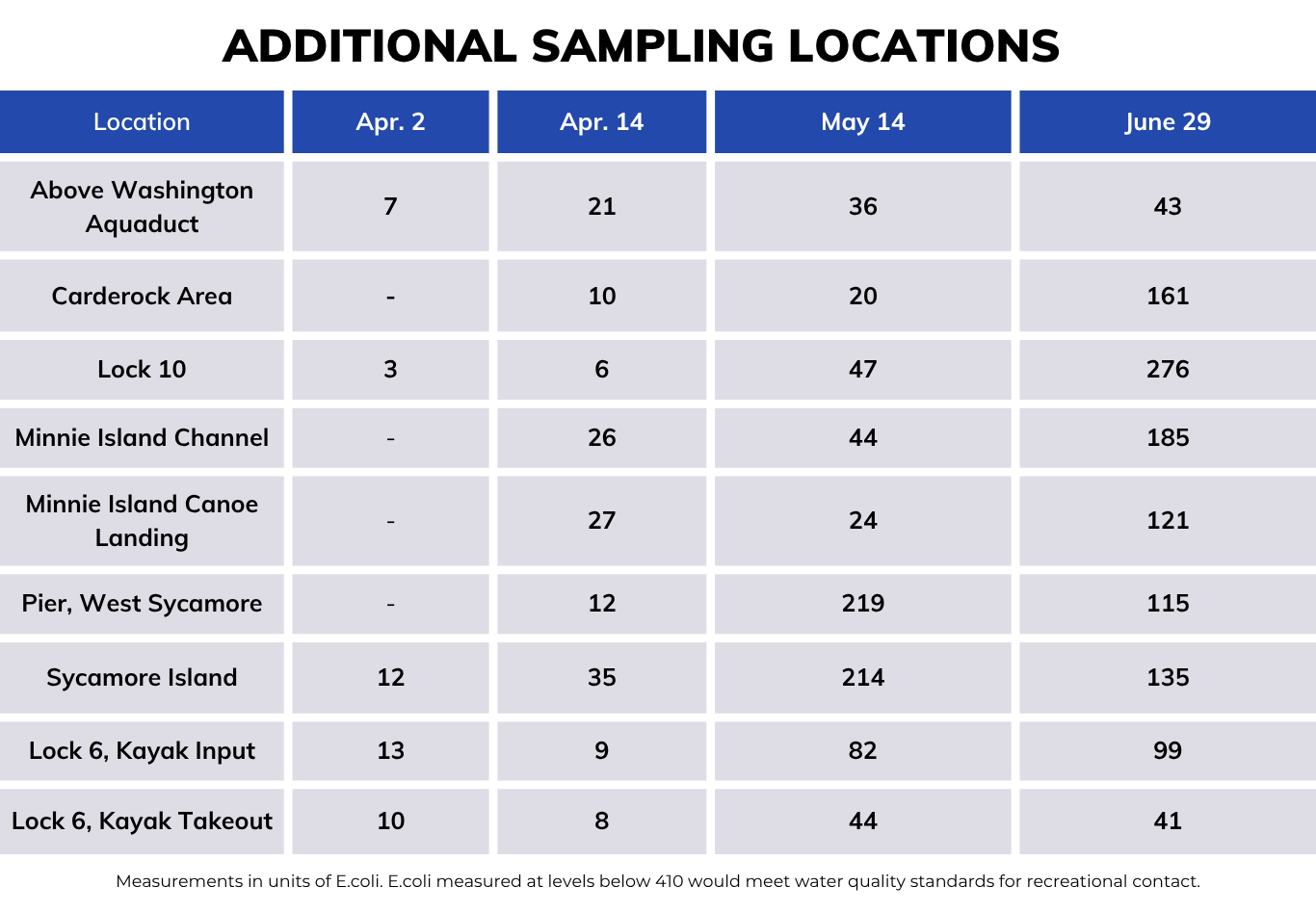
Based on community feedback, several testing locations were added in April 2026:
MDE collected sediment samples downstream of the spill to better understand whether sewage had settled in areas frequently used by the public. The samples were analyzed by the University of Maryland’s Water Quality, Outreach and Wellness (WOW) Laboratory for several indicators associated with human and animal waste, including bacteria and human fecal markers. Because sediment testing for these indicators is still an emerging science, there are no established standards or thresholds for determining health impacts. However, the results do show the presence of sewage-related markers in some areas, particularly around Minnie’s Island.
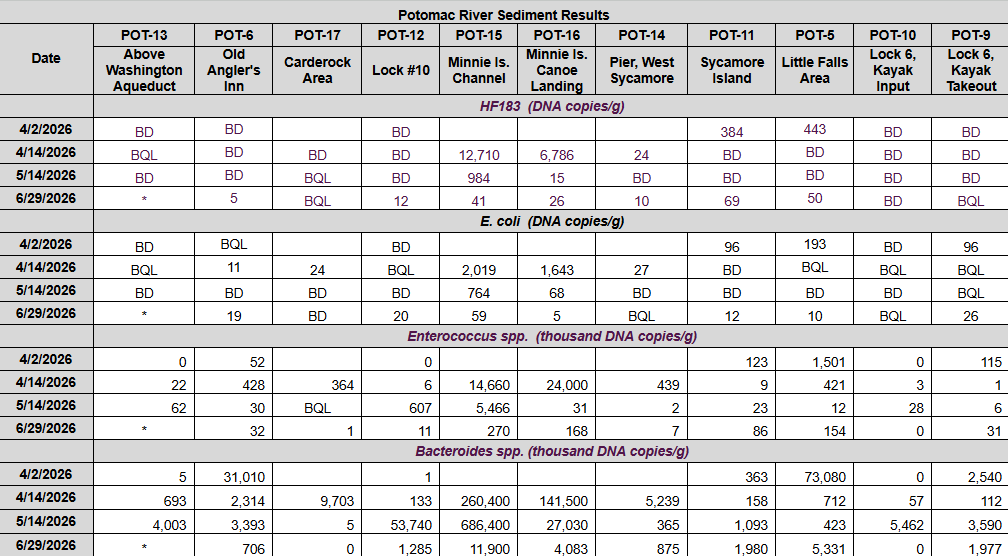
BD = Below Detection; BQL = Below Quantification Limit, *The extracted DNA concentration for the Pot-13 sample was so low that we did not run this sample using dPCR.
Press Releases
Maryland health officials provide update on recreational water advisory for Montgomery County impacted by Potomac Interceptor spill (March 17, 2026).
Maryland Department of the Environment Lifts Precautionary Shellfish Harvesting Closure in Potomac River (March 10, 2026).
Maryland Health Officials Provide Update on Recreational Water Advisories for Counties Impacted by Potomac Interceptor Spill (March 5, 2026).
Maryland Department of the Environment Releases Latest Sampling Results Maintaining Positive Shellfish Conditions After Potomac Interceptor Spill (Feb. 25, 2026).
Maryland Department of the Environment issues update on Potomac Interceptor support and response (Feb. 20, 2026).
Key Agencies
-
District of Columbia Water and Sewer Authority (DC Water): Pipe owner/operator; responsible for bypass, repairs, cleanup, and public signage. Gives operational updates to state and federal partners
-
United States Environmental Protection Agency (EPA): Primary regulator and lead federal enforcement and compliance authority; enforces federal Clean Water Act regulations and oversees DC Water/Blue Plains consent decree.
-
Maryland Department of the Environment (MDE): Regulates unauthorized discharges into Maryland waterways and wetlands, monitors shellfish harvesting, and oversees drinking water safety and enforcement.
-
Maryland Department of Health: Coordinates with local health departments on water contact advisories.
-
Virginia DEQ & VDH: Monitors downstream water quality and public health.
-
DC Department of Energy and Environment:
Supports water, quality, monitoring, and issuing public health advisories for District residents.
-
Supporting Entities: National Park Service and the Interstate Commission on the Potomac River Basin coordinate monitoring, modeling, and river management, as well as oversee some permitting.
Environmental Impacts
Category |
Status |
Details |
Drinking Water |
SAFE |
Intakes are located upstream of the spill. |
Shellfish |
CLOSURE LIFTED |
Precautionary closure from Charles County to Nice Bridge lifted March 10. No active leases and no closures further downstream. |
Recreation |
PARTIALLY LIFTED |
Health advisory partially lifted in Montgomery County. |
Recreation |
ADVISORIES LIFTED |
Health advisories no longer active in Prince George’s and Charles Counties. |
Containment |
EMERGENCY REPAIRS COMPLETED |
Sewage flow that had been carried via installed bypass returned to Potomac Interceptor.
|
Maryland Department of the Environment (MDE) Response Actions
Coordination, Directions and Inspections
The response efforts include daily coordination, with consistent site visits. The primary goal of these visits is to oversee containment activities and assess the extent of the environmental damage caused by the incident.
Shellfish Protections
To safeguard public health and ensure consumer safety, a precautionary harvesting closure has been issued, encompassing the area from Charles County up to the Route 301 Bridge. As part of this measure, water samples are being collected and sent for analysis.
Ongoing Monitoring
A coordinated monitoring plan has been implemented to track the situation at the spill site and other locations in Maryland and Washington, D.C. As ice continues to clear, efforts will focus on collecting additional samples from open water areas.
Health Coordination
State and local health departments are receiving support to disseminate essential public safety advisories in the three counties impacted by the incident, ensuring residents are informed and protected.
Long-Term Recovery
Restoration plans for the affected areas will be reviewed and approved in close coordination with key partners, including the U.S. EPA and the National Park Service.
Federal Regulatory Documents for DC Water
Discharge permit issued by U.S. EPA to DC Water for the operation of its treatment plant and sewer system, including the Potomac Interceptor
EPA information letter to DC Water
Additional information
MDE Inspection Reports (enter site number 72092)
